
Reviewing TryHackMe's PT1 Certification
An honest review of TryHackMe's PT1 entry-level pentest certification: web exploitation, network pentesting, AD attacks, and how it reads as OSCP prep.
Real-world pentest practice across Web, Network & Active Directory
TL;DR
- Three realistic engagements (Web, Network, AD) + a full professional report.
- Total effort: ~20 active hours over a 34-hour window.
- Trickiest domain: Web; easiest: Active Directory.
- Biggest gripe: in-portal report UI.
- Verdict: Superior hands-on value compared with eJPT, but price stings for learners in emerging-market economies like Brazil.
1. Why I Sat the Exam
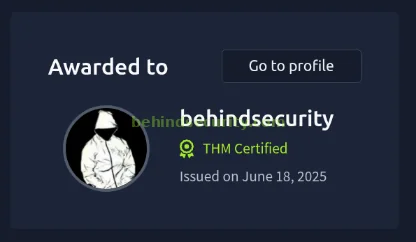
A limited-time promotion offered free PT1 vouchers to existing cert-holders. Thanks to my eJPT credential, I grabbed a code on 16 June 2025, booked immediately, and earned the certification two days later.
2. Preparation Strategy
Do you need months of study? Probably not, if you already:
- Grind CTF boxes regularly.
- Complete the PT1 learning path rooms.
- Understand fundamentals of pentest report writing.
Because I ticked those boxes, I skipped formal prep. For newcomers, the official TryHackMe rooms remain excellent step-by-step training.
3. The Exam Lab Experience
| Domain | Difficulty (subjective) | Notes |
|---|---|---|
| Web | X X X | Broad attack surface; expect to juggle multiple vuln classes. |
| Network | X X | Straightforward enumeration & exploitation. |
| AD | X X | Well-signposted attack path; privilege escalation felt natural. |
- Lab stability: Bulletproof, no disconnects or resets observed.
- Time spent: ~20 productive hours (excluding sleep/eating), 34 hour total exam time.
- No custom 0-days required: Standard tooling and publicly known exploits sufficed.
4. Reporting & Portal Pain Points
What worked
- AI feedback on findings felt on-point, despite community skepticism.
What didn’t
| Issue | Impact | Work-around / Feature request |
|---|---|---|
| Dropdown mis-clicks while mapping findings to vuln IDs | Cost me points until manual review | Double-check every selection before submission |
| Limited formatting / templates in portal | Forces you into a clunky editor | Feature request: allow external report uploads (e.g., PDF generated in Sysreptor) |
Many pentesters already draft client-ready reports in tools like Sysreptor or Dradis. Letting candidates upload a finished PDF would not only preserve their established workflow, but showcase real-world report quality and reduce friction with the current in-browser editor.
5. Lessons Learned & Pro Tips
| Tip | Why it matters |
|---|---|
| Treat the Web engagement as your time sink | It has the broadest scope; budget hours accordingly |
| Take notes | Notes remain mandatory: you’ll have a hard time if yours aren’t organized |
| Ask for manual score review if you suspect grading glitches | Support was responsive and corrected my score promptly |
6. Value & ROI
Compared with eJPT, PT1 feels notably more realistic: zero hints, fuller reporting requirement, broader domain coverage. Pricing caveat: At $297 (regular price), it’s a steep ask for students in developing regions. A tiered “emerging-market” store, like CompTIA’s, would widen access.
7. Final Verdict
Despite minor UX quirks, TryHackMe PT1 delivers an authentic pentest simulation, ideal for practitioners who want to bridge the gap between CTF wins and client-facing engagements. If you already have solid fundamentals, expect a challenging yet achievable weekend sprint that produces a portfolio-worthy report.
Have questions?
Feel free to ping me or drop a comment. Happy to share more war stories and resources!